

If you’ve ever closed a support ticket and wondered whether the customer actually walked away happy, that’s exactly what CSAT is built to answer. It’s one of the simplest metrics in customer support, but a lot of teams still get the math wrong or track it inconsistently, which makes the number useless for decision-making.
This guide breaks down the exact CSAT formula, walks through a real calculation example, and shows you exactly what to do with the number once you have it in front of you.
What Is CSAT?
CSAT stands for Customer Satisfaction Score. It’s a metric that measures how satisfied a customer is with a single interaction, such as a support ticket, a purchase or a product feature, based on their survey response right after that interaction happens.
Unlike broader loyalty metrics, CSAT is intentionally narrow. It doesn’t ask customers if they’ll recommend you to a friend. It asks a simple question: how did this specific experience make you feel?
What Is the CSAT Score Formula?
The CSAT formula is:
CSAT Score = (Number of Satisfied Customers ÷ Total Number of Survey Responses) x 100
Here’s what counts as “satisfied”:
- On a 5-point scale, ratings of 4 and 5 count as satisfied
- On a 3-point scale, only the top rating counts as satisfied
- On a 10-point scale, ratings of 8, 9 and 10 typically count as satisfied
Neutral and negative responses are excluded from the numerator but still included in the total count used in the denominator.
How Do You Calculate CSAT Score Step by Step?
Calculating CSAT is straightforward once you break it down into a repeatable process. Here’s exactly how it works, from sending the survey to reading the final number.
- Pick a survey scale and stick with it. Most teams use a 1 to 5 scale (bad to great), though 1 to 3 and 1 to 10 scales work too. What matters more than the scale itself is consistency, since switching scales mid-quarter makes month-over-month comparisons meaningless.
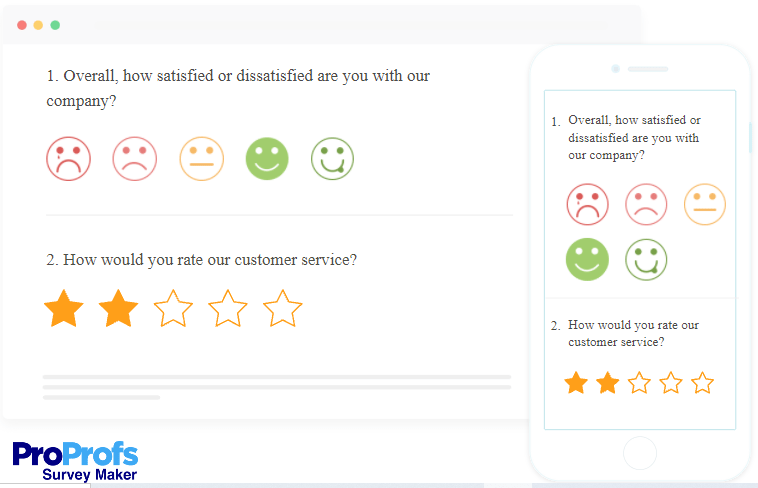
- Send a one-question survey right after the interaction. Ask something direct, like “How satisfied were you with this support experience?” Attach it to the ticket-closing email or trigger it inside the chat window so the customer doesn’t have to go looking for it later.
- Collect responses over a set time period. A week works well for high-volume teams, while a month works better for smaller ones. Make sure the window is long enough to gather at least 20 to 30 responses, otherwise a couple of outlier ratings can swing your score more than they should.
- Count only the satisfied responses. On a 5-point scale, add up every rating of 4 and 5. Don’t worry about how many people rated you 3 or lower at this stage, that number matters later, just not for this part of the calculation.
- Divide by total responses and multiply by 100. Take your count of satisfied responses, divide it by every response you collected (including the neutral and negative ones), then multiply by 100. That final number is your CSAT score for the period.
- Segment the score before you act on it. A single blended number is a useful headline figure, but breaking it down by agent, channel or ticket type almost always tells you more about where that number is actually coming from.
CSAT Calculation Example
Say your support team collected 200 responses to a post-ticket survey last month, using a 1 to 5 rating scale.
- 90 customers rated their experience a 5
- 60 customers rated it a 4
- 30 customers rated it a 3
- 15 customers rated it a 2
- 5 customers rated it a 1
Satisfied responses (ratings of 4 and 5) = 90 + 60 = 150
CSAT Score = (150 ÷ 200) x 100 = 75%
That means 75 out of every 100 customers who responded had a positive experience with your support team last month.
FREE. All Features. FOREVER!
Try our Forever FREE account with all premium features!
What Is a Good CSAT Score?
Most support teams treat a CSAT score of 75% to 80% as solid performance, with anything above 85% considered excellent. Scores below 65% usually signal a real problem with response quality, resolution time or agent training that needs attention.
A study by Forrester in 2025 found that customer satisfaction hit an all-time low in North America that year, with 18% of brands declining, only 9% improving, and the rest staying flat. That’s a reminder that a “good” score isn’t static. It’s worth comparing your CSAT against your own past performance, not just an industry number, since customer expectations keep shifting.
Why Does CSAT Score Matter?
A support team without a CSAT score is flying blind. You might feel like customers are happy, but feelings aren’t data, and the people who stay quiet after a bad experience are usually the ones who quietly stop being customers. CSAT is one of several help desk metrics worth tracking, but it’s the one that most directly reflects how a customer felt in the moment.
CSAT solves a few specific problems:
- It flags bad experiences early, before they show up as churn or a bad review
- It gives agents a clear performance signal tied to real customer feedback, not guesswork
- It shows leadership where support is actually breaking down, whether that’s response time, tone or resolution quality
- It replaces messy manual tracking, like the spreadsheets and shared inboxes many small teams still rely on
What Affects Your CSAT Score?
CSAT doesn’t move on its own. A handful of specific factors drive it up or down:
- Response time. Slow first responses almost always lower satisfaction, even if the eventual resolution was fine. Tracking ticket response time separately from resolution time makes it easier to see where the delay actually happens.
- Resolution time. Tickets that drag across multiple days frustrate customers regardless of the final outcome. This is closely tied to first contact resolution, since tickets solved on the first try almost always score higher.
- Agent tone. Scripted or robotic replies score lower than replies that sound like they came from a person who actually read the ticket.
- Number of touchpoints. Customers who have to repeat themselves across multiple agents or channels report lower satisfaction.
- Survey timing. Surveys sent too long after the interaction get lower response rates and less accurate scores.
How Can You Improve Your CSAT Score?
These customer service tips apply directly to CSAT, since almost everything that improves the customer experience also improves the score:
- Cut your first response time. Customers judge you within the first reply, often before the issue is even solved.
- Reduce back-and-forth. Give agents the context they need upfront so customers aren’t repeating themselves.
- Train agents on tone, not just resolution. A correct answer delivered coldly still scores poorly.
- Send the survey immediately after ticket closure, while the interaction is still fresh.
- Review low scores individually, not just in aggregate. A single 1-star rating often has a specific, fixable cause.
This is exactly where a proper help desk tool earns its keep. ProProfs Help Desk is a simple, all-in-one help desk software that helps support teams track, measure and improve CSAT without the cost or complexity of a bloated CRM.
FREE. All Features. FOREVER!
Try our Forever FREE account with all premium features!
How Does ProProfs Help Desk Track CSAT?
If you’re currently calculating CSAT by hand in a spreadsheet, or worse, not tracking it at all, this is the part worth paying attention to. ProProfs Help Desk is a simple, all-in-one help desk software that helps support teams track, measure and improve CSAT without the cost or complexity of a bloated CRM, which matters a lot for lean teams who don’t have a dedicated ops person to maintain reports.
Here’s what it does out of the box:
- Uses help desk automation to send a CSAT survey the moment a ticket is closed, so you never miss a response window
- Calculates CSAT score in real time through built-in reports and tracking, no manual math required
- Uses AI to Decode Intent and Mood on incoming tickets, so agents can catch a frustrated customer before the survey even goes out
- Breaks down CSAT by agent, team and channel so you know exactly where scores are slipping
- Runs on a shared inbox with child tickets, so nothing gets lost between departments
- Comes with a forever-free plan for a single agent, with paid plans starting at $19.99 per user per month
If your team is also managing a knowledge base to reduce repeat tickets, ProProfs Knowledge Base plugs into the same ecosystem, and if you want more detailed feedback beyond a single CSAT question, ProProfs Survey Maker handles longer post-support surveys.
How Is CSAT Different From NPS and CES?
CSAT, NPS and CES all measure customer sentiment, but they answer different questions and belong in different parts of the customer journey. If you’re comparing all three, this breakdown of customer satisfaction metrics covers how each one fits into a broader measurement strategy.
| Metric | What It Measures | When to Use It |
| CSAT | Satisfaction with one specific interaction | Right after a ticket, purchase or support chat |
| NPS | Long-term loyalty and likelihood to recommend | Quarterly or after a meaningful relationship milestone |
| CES | How much effort a customer had to put in | Right after a task the customer had to complete themselves |
Use CSAT for day-to-day support quality checks, NPS for tracking overall brand loyalty, and CES for spotting friction in self-service or onboarding flows. Most mature support teams track all three, but CSAT is usually the first one worth setting up since it’s the fastest to act on.
Start Turning Your CSAT Score Into Better Support Decisions
Calculating CSAT was never the hard part. It’s one formula, repeated consistently, on a survey you’re probably already capable of sending today. The real value shows up once you stop treating it as a one-time report and start checking it the same way you’d check response time or ticket volume, on a regular schedule, broken down by agent and channel, not just as one number for the whole team.
Once you have a reliable score, the next step is acting on it. A dip after a product change, a specific agent trending lower, a channel that consistently underperforms, these are the kinds of patterns that tell you exactly where to focus, instead of guessing at what might be going wrong.
If manually running these numbers every week sounds like one more task on an already full plate, most modern help desk tools, ProProfs Help Desk included, can handle the survey and the math automatically, so the score is just there waiting for you instead of something you have to build from scratch.
Frequently Asked Questions
What is a good CSAT score?
A CSAT score between 75% and 80% is generally considered good, and anything above 85% is excellent. Scores under 65% usually point to a real service issue worth investigating.
How do you calculate a CSAT score from percentages instead of ratings?
If your survey already uses a percentage scale (0 to 100%), treat any response of 80% or higher as satisfied, then apply the same formula: satisfied responses divided by total responses, times 100.
Can a CSAT score be negative?
No. CSAT is always expressed as a percentage between 0% and 100%, since it only counts positive responses against the total.
How often should you measure CSAT?
Measure CSAT continuously, right after each interaction, but review the trend weekly or monthly. A single day's score isn't reliable due to small sample size.
How many survey responses do you need for an accurate CSAT score?
There's no fixed number, but fewer than 20 to 30 responses in a period can make your CSAT score swing wildly from a handful of outliers. Aim for a consistent, larger sample before drawing conclusions.
Is CSAT the same as customer retention?
No. CSAT measures satisfaction with a single interaction, while retention measures whether a customer keeps buying over time. A customer can rate one ticket 5 stars and still churn later for unrelated reasons, which is why it's worth pairing CSAT with dedicatedcustomer retention strategies rather than relying on one metric alone.
What's the best CSAT survey question to ask?
Keep it short and specific, like "How satisfied were you with your support experience today?
" paired with a 1 to 5 scale. Avoid vague or multi-part questions that confuse the rating.
Do neutral responses count toward your CSAT score?
Neutral and negative responses are excluded from the "satisfied" count in the numerator, but they still count toward the total number of responses in the denominator, which is what pulls your score down.
FREE. All Features. FOREVER!
Try our Forever FREE account with all premium features!

 We'd love your feedback!
What did you like & how can we make it even better?
 Thanks for your feedback!
 Ask Your Question
Have a question? Get expert help to make your decision easier.