

One missed email can frustrate a customer. Two can send them to your competitor.
Over the years, I’ve worked with support teams that handled hundreds of customer emails daily, from simple product questions to urgent complaints and refund requests. While email remains one of the most preferred support channels, managing a growing inbox without the right tools can quickly become overwhelming.
That’s where customer service email management software comes in. The right tool doesn’t just help you reply faster. It gives you visibility into what’s piling up, who owns what, whether SLAs are at risk, and where your team can automate to save 7-8 hours every week. It turns a chaotic inbox into an actual workflow.
In this guide, I’ll share the 10 best customer service email software solutions I’ve used, researched, and evaluated. Whether you run a small business or manage a large support team, these tools can help you improve response times, boost agent productivity, and deliver a better customer experience this year.
What Is Customer Service Email Software?
Customer service email software is a tool that helps businesses manage, organize, and respond to customer emails from a centralized platform. Instead of juggling multiple inboxes, support teams can track conversations, assign emails to the right agents, and ensure that no customer query slips through the cracks.
Modern email support software goes beyond basic inbox management. It often includes features such as automation, canned responses, ticketing, collaboration tools, analytics, and AI-powered assistance to help teams respond faster and deliver a more consistent customer experience. As email volumes grow, these tools make it easier to maintain high service standards without overwhelming support agents.
10 Best Customer Service Email Management Software
There’s no shortage of blogs recommending customer service email software, which can make choosing the right tool feel overwhelming. That’s why I took the time to carefully evaluate the options and narrow the list down to the solutions that truly stand out.
Over the past seven years, I’ve worked with and researched a wide range of customer support tools. Some of the software on this list I’ve used firsthand, while others were recommended by experienced colleagues or consistently earned high ratings across trusted software review platforms.
The result is a well-researched list based on practical experience, industry insights, and extensive evaluation; not just marketing claims.
| Tool | Best For | Pricing |
| ProProfs Help Desk | AI-powered ticket summarization & response suggestions | Starts at $19.99/user/month |
| Hiver | Email support inside Gmail | Starts at $19/user/month |
| HelpSpot | Organizing customer requests in one place | Starts at $699/year (3 users) |
| Zendesk | AI-powered service | Starts at $55/user/month |
| Freshdesk | Omnichannel support | Starts at $15/user/month |
| Zoho Desk | Personalized service with automated prioritization | Starts at $14/month |
| HubSpot Service Hub | Unified sales, marketing & support for HubSpot CRM users | Starts at $15/user/month |
| Spiceworks | Cloud accessibility | Free |
| ManageEngine | Workflow automation | Starts at $10/month |
| Help Scout | Managing client communication | Starts at $20/user/month |
1. ProProfs Help Desk – Best for AI Help Desk & Support Ticketing for Customer Delight
ProProfs Help Desk has become an integral part of our customer service operation. It’s surprisingly easy to use, with a clean and intuitive design that makes it a favorite among our team members, regardless of their technical skills. I’ve found it to be a very efficient system for managing support emails, along with chats, web forms, and social media queries.
With the shared inbox feature, I can track multiple email accounts like support@, returns@, billing@, etc., in one place. Incoming emails are automatically converted into trackable tickets, allowing us to prioritize, assign, and monitor progress effectively.
What truly impresses me about ProProfs Help Desk is its AI-powered help desk features, like ticket summarization of lengthy email threads and intelligent response suggestions, which have greatly improved our team’s efficiency. AI-powered reports even tell us which types of tickets are recurring and which agents need further training.
Overall, ProProfs Help Desk has proven to be a valuable asset in our efforts to provide excellent customer service.
Pros:
- Shared inbox to track multiple team inboxes (like support@, info@, returns@, etc.) in one place
- SLA Management to track response times and escalation deadlines
- Automated ticket assignment to ensure efficient workload distribution
- Customer Delight Suite combines Ticketing + Chat + Knowledge Base + Survey for a complete support solution
Cons:
- A dark user interface option is not available
- No downloadable or on-premise version
Pricing:
A free plan is available for growing teams. Paid plan starts at $19.99/user/month.
2. Hiver – Best for Email Support
Hiver is a really interesting option for customer service email management because it’s built right inside Gmail. This means your team doesn’t have to learn a whole new platform, which can be a huge time-saver. It’s known for being super user-friendly and intuitive, even for those who aren’t tech-savvy.
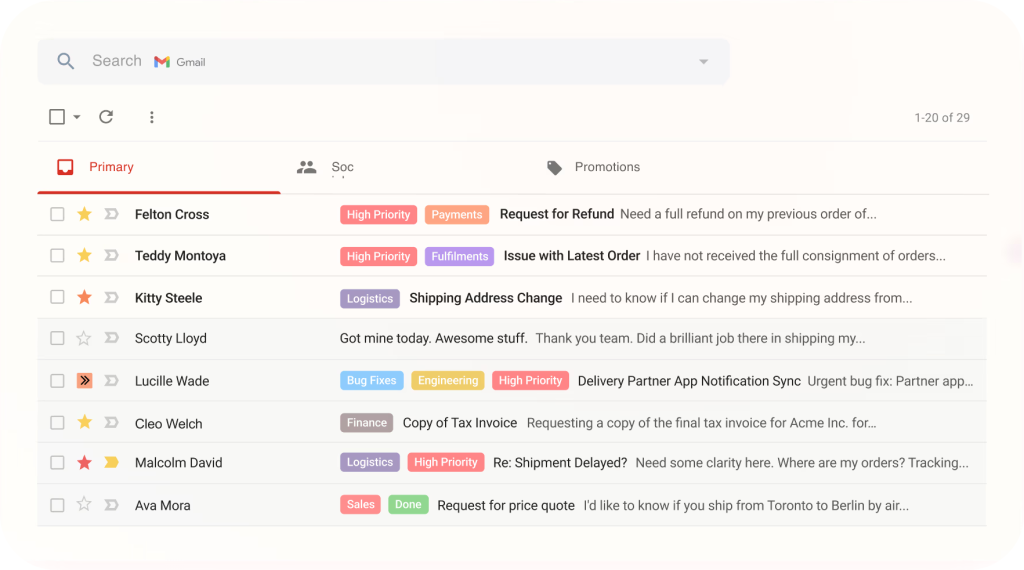
One of the things that makes Hiver stand out is its focus on collaboration. It allows your team to work together seamlessly on emails, assign tasks, and track progress, all without leaving your Gmail inbox. This can really boost efficiency and improve response times.
Hiver also offers some great features for streamlining your workflow, like email templates, automation, and collision detection. This helps you avoid duplicate replies and ensures that nothing slips through the cracks. If you’re looking for a simple yet powerful solution that integrates seamlessly with Gmail, I highly recommend giving it a try.
Pros:
- Email templates to ensure consistency and save valuable time
- Email notes to add internal information to emails
- Collision alerts to avoid duplicate replies and confusion
- Automated email routing to direct incoming messages to the appropriate agent
Cons:
- Hiver is exclusively tailored for Gmail, limiting its compatibility with other communication channels
- Enhanced reporting metrics and charts are missing from the tool’s offerings
Pricing:
Starts at $19/user/month.
3. HelpSpot – Best for Organizing Customer Requests
HelpSpot is a popular customer service tool that helps you organize and manage all customer requests in one place. With HelpSpot, you have a centralized inbox that keeps all customer requests organized and easily accessible, so you never miss a beat.
What’s more impressive is that you can manage and reply to your tickets with a clean single-page interface. You can use a WYSIWYG editor or Markdown to create detailed responses and insert pre-written replies with #.
What I found more interesting is that you can assign tickets to specific agents, ensuring clarity and accountability. Plus, the knowledge base helps create and store helpful resources, speeding up ticket resolution and reducing customer inquiries.
Pros:
- Email ticketing to convert your emails into trackable tickets
- Built-in knowledge base to reduce incoming emails and frees up your team’s time
- Automated workflows to streamline your processes with customizable rules and triggers
- Intuitive interface to quickly learn and use the software with ease
Cons:
- The software is not very scalable and may slow down with a high volume of tickets
- Limited reporting features
Pricing:
Starts at $699/year (for 3 users).
4. Zendesk – Best for AI-Powered Service
Another customer email management software I would recommend is Zendesk. The AI feature of this tool is already making waves by speaking the language of customer service like no other.
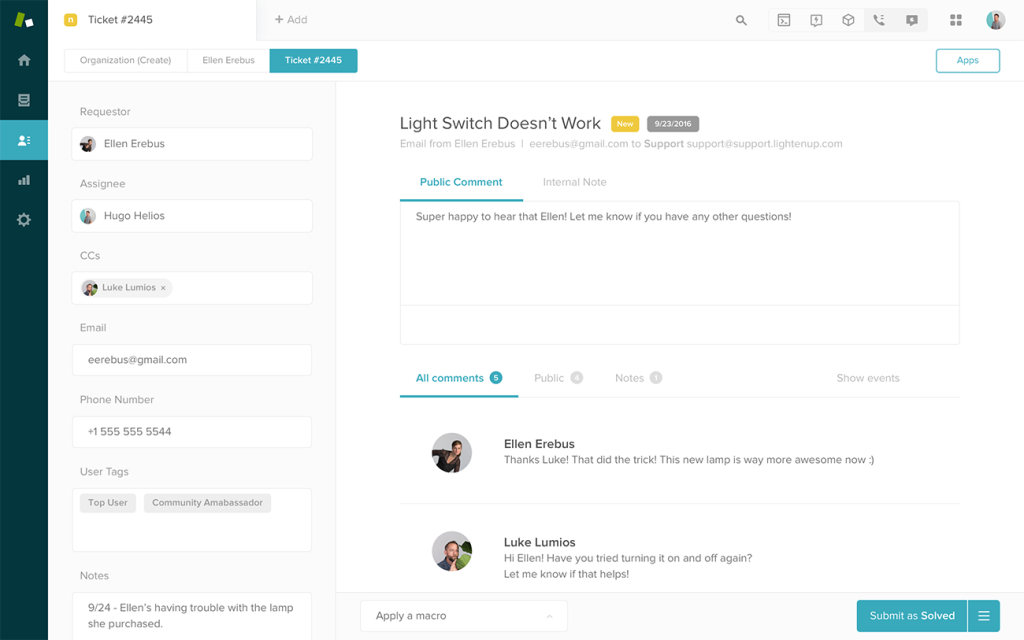
Plus, it has a ton of features packed into a platform that’s surprisingly easy to navigate.
What impressed me most was how Zendesk takes all those customer emails and turns them into organized tickets. This makes it super easy to track conversations, see who’s handling what, and make sure nothing falls through the cracks.
Honestly, Zendesk has made a noticeable difference in how we handle customer emails. It’s more efficient and organized, and ultimately, it’s helped us provide better support. If you’re struggling to manage your customer emails, I’d definitely recommend giving Zendesk a closer look.
Pros:
- Unified workspace for multi-channel support management
- Modular architecture for customizable software configurations
- Robust ticketing and routing system for efficient organization
- Powerful analytics and reporting tools for performance measurement
Cons:
- Additional charges for certain features, such as IVR call routing and Answer Bot
- It may not suit small businesses needing a simple and affordable solution
Pricing:
Starts at $55/user/month.
5. Freshdesk – Best for Omnichannel Support
Freshdesk is a robust help desk software that’s known for its ease of use. It helps you keep track of all your customer emails by turning them into organized tickets. This makes it simple to answer questions and solve problems without anything getting lost.
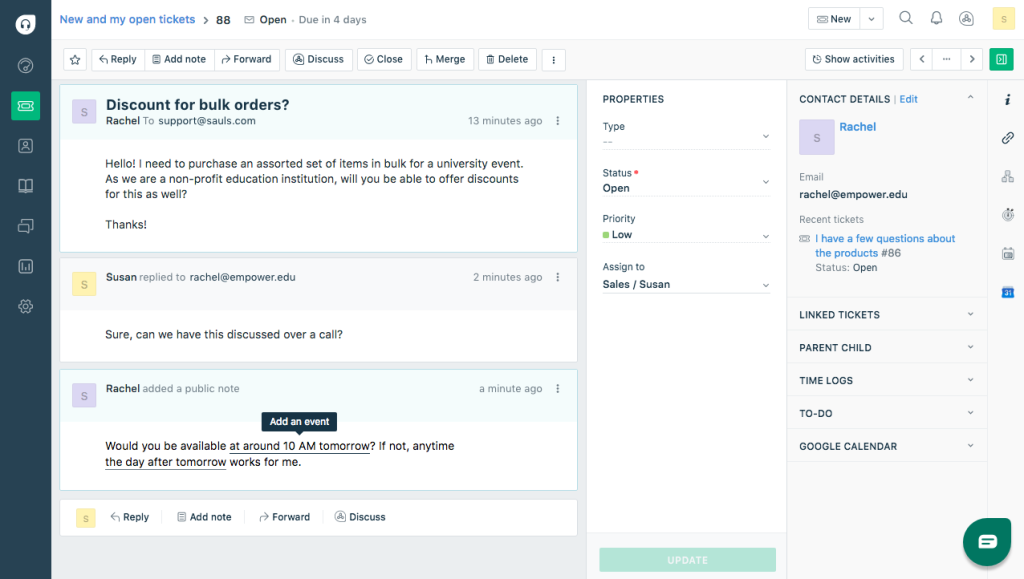
With Freshdesk, businesses can handle customer queries across email, chat, social media, and phone from a single, intuitive dashboard. This omnichannel solution enables support teams to respond quickly and effectively, regardless of the customer’s preferred communication channel.
A feature that stands out to me is the AI-powered self-service option, utilizing Freshbots to deliver quick answers and cut down wait times, which really enhances issue resolution. I also like its unified agent workspace that significantly boosts productivity, resulting in better customer satisfaction and a smoother support process.
Pros:
- Advanced ticketing system to resolve customer issues
- Streamlined admin tools to drive efficiency through AI-powered workflow automation
- Multi-channel support to give a unified view of all customer interactions.
- Self-service portal to reduce your team’s workload
Cons:
- Freshdesk’s third-party integrations are available only with paid plans
- The free and growth plans lack key features like team dashboards, chatbots, and social ticketing
Pricing:
Starts at $15/user/month.
6. Zoho Desk – Best for Personalized Service
Zoho Desk is another big name in the customer service email management space. Known for its user-friendly interface and high level of customization, it seamlessly adapts to your unique workflows. Plus, it integrates smoothly with other Zoho applications you may already be using.
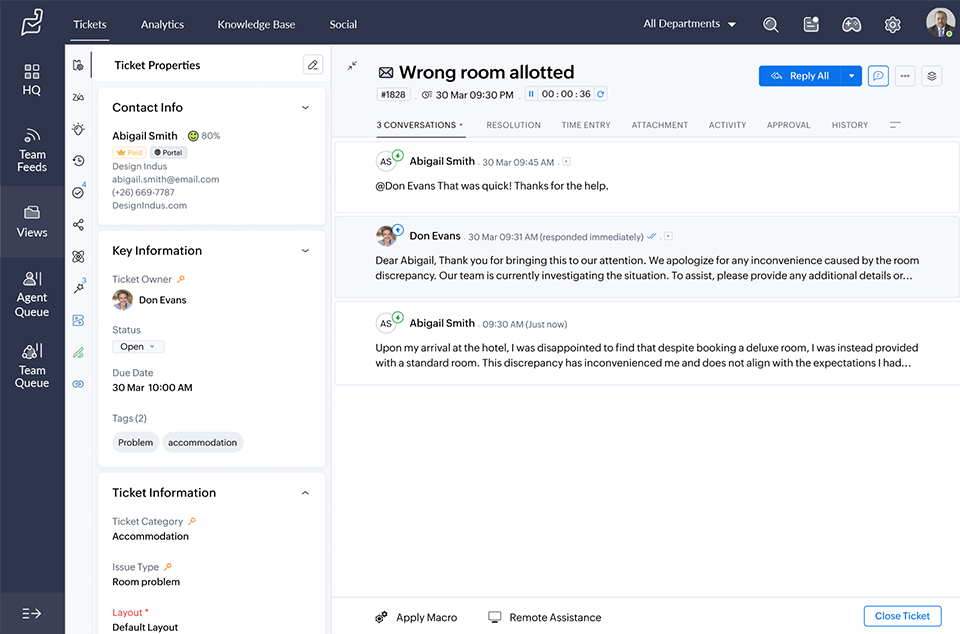
One of the things I really like about Zoho Desk is the way it helps you prioritize your emails. You can set up rules to automatically categorize and prioritize incoming messages, so you can focus on the most urgent issues first. And their reporting features are pretty impressive too – you can get a clear picture of your team’s performance and identify areas for improvement.
From my experience, Zoho Desk is a reliable and efficient tool that can really help you streamline your customer service emails. If you’re looking for a well-rounded and customizable solution, Zoho Desk is definitely worth considering.
Pros:
- Automated ticket management to streamline your workflow
- SLA Management to ensure the timely resolution of customer issues
- Multi-channel support to manage customer interactions from various channels
- Zoho’s AI assistant, Zia, automates tasks like tagging tickets and suggesting solutions
Cons:
- Some users have reported that the customer support team is not as responsive or helpful as they claim to be
- Zoho Desk can be slow or laggy, especially when dealing with large volumes of tickets
Pricing:
Starts at $14/month.
7. HubSpot Service Hub – Best for HubSpot CRM Users
HubSpot simplifies customer service operations by consolidating all customer data and communication channels within a single, unified platform. It’s a favorite among businesses of all sizes, thanks to its ability to streamline workflows and improve customer interactions.
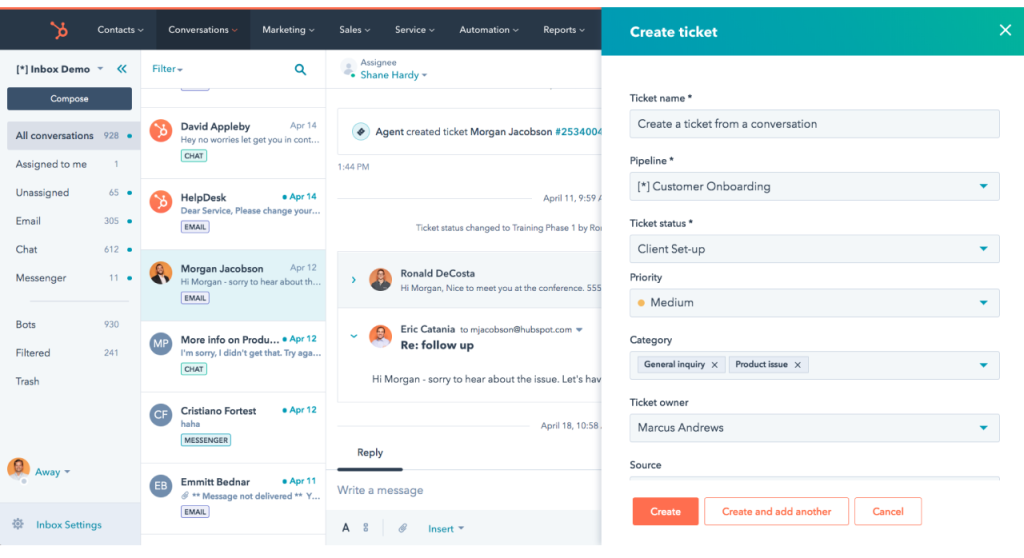
HubSpot Service Hub is perfect for users of HubSpot CRM, providing a cohesive platform that connects sales, marketing, and customer service efforts. This integration empowers businesses to improve customer relationships by offering personalized support.
Plus, HubSpot excels at bringing all your customer interactions together. Whether it’s email, live chat, social media, or phone calls, you can manage everything from one central location. This omnichannel approach ensures a consistent and seamless experience for your customers, no matter how they choose to connect with you.
Pros:
- Conversations inbox to manage all interactions seamlessly
- Customer feedback tools to gather valuable insights into customer satisfaction
- Integration with a wide range of other business software
- User-friendly interface with a simple setup process
Cons:
- Limited customization options
- The pricing structure is complex, with some features needing higher-tier plans
Pricing:
Starts at $15/user/month.
8. Spiceworks – Best for Cloud Accessibility
Spiceworks is ideal for businesses seeking cloud accessibility, allowing users to manage support tickets from anywhere without needing specialized software. Its web-based platform ensures that teams can efficiently collaborate and respond to customer inquiries.
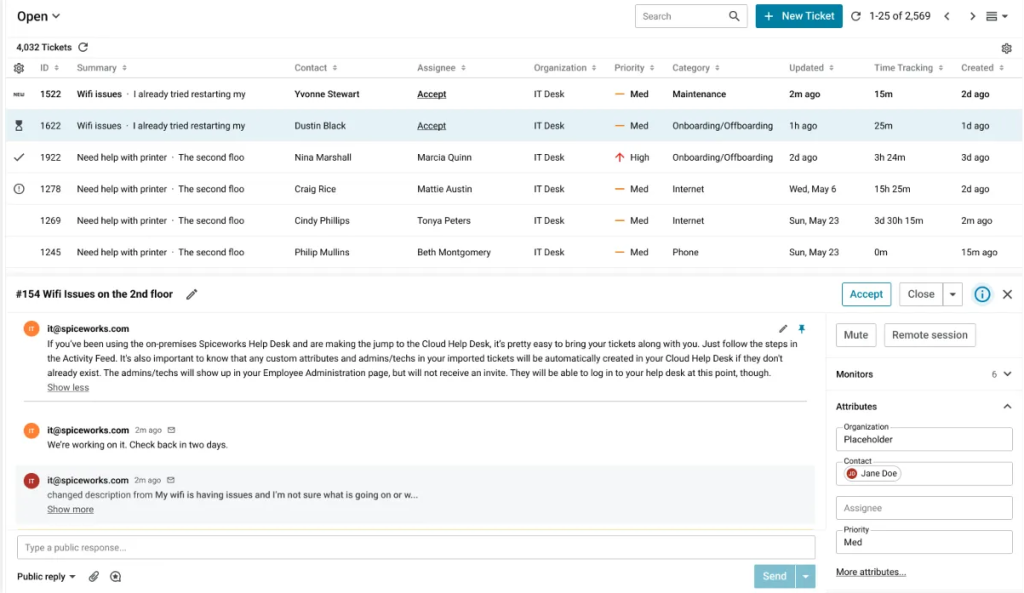
Users can easily create and manage tickets generated from emails, which allows for streamlined communication and issue tracking. The software also offers customizable features that let you tailor workflows and response management to suit your organization’s needs, improving overall productivity.
I appreciate its automation capabilities, which allow businesses to set up automated responses, rules, and ticket views. This functionality streamlines workflows and improves efficiency in managing customer inquiries.
Pros:
- Advanced reporting capabilities to provide key performance and capacity data
- Robust security features to protect sensitive customer data
- Cloud accessibility allows teams to work remotely and efficiently manage customer inquiries
- Robust ticketing system to create, manage, and track support requests efficiently
Cons:
- It can be slow and unresponsive on large networks with a lot of devices
- Spiceworks is supported by advertising. Some users find the ads to be intrusive or annoying
Pricing:
Free for all users.
9. ManageEngine – Best for Workflow Automation
ManageEngine offers a robust and reliable solution for customer service email management, particularly well-suited for organizations with complex IT environments. As part of a comprehensive suite of IT management tools, it seamlessly integrates with existing infrastructure and provides a unified platform for managing various IT service needs.
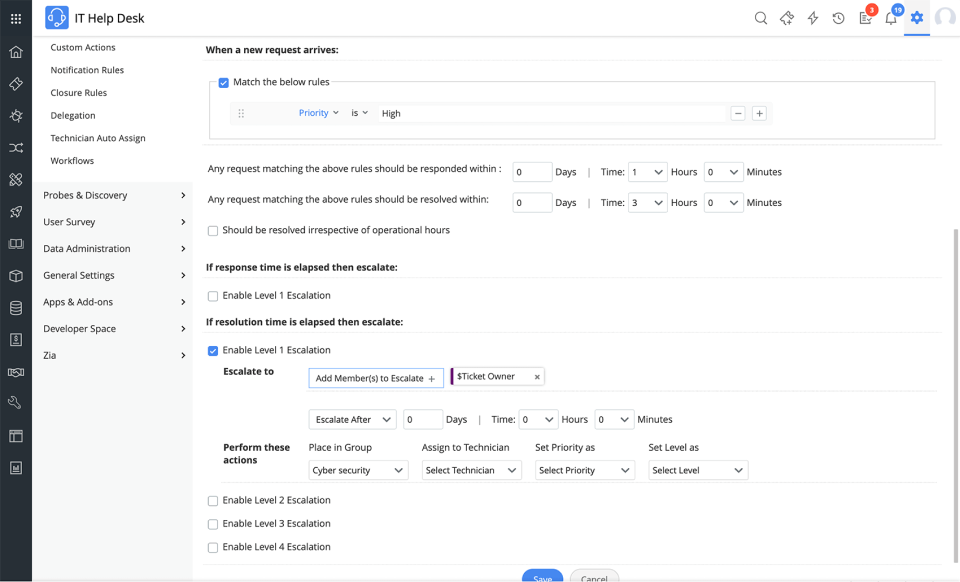
One of the best things about ManageEngine is its powerful automation engine. It can handle a wide range of tasks, from automatically categorizing and routing incoming emails to escalating urgent issues and even suggesting responses. This can seriously boost your team’s efficiency and help you provide faster, more consistent support.
But it’s not just about automation. ManageEngine also provides a comprehensive set of features for managing your customer interactions, including a self-service portal, SLA management, and detailed reporting. While the interface may not be the most modern, it’s packed with features and offers great value, particularly for businesses with complex IT needs.
Pros:
- Predefined response templates to save time and ensure consistency
- ManageEngine mobile app for on-the-go support
- Seamlessly integration with other ManageEngine solutions for a unified IT management experience
- Intelligent ticket routing to ensure that issues are addressed by the right people quickly
Cons:
- Setting up Spiceworks may require some technical expertise
- Users have reported occasional bugs or glitches, especially after update
Pricing:
Starts at $10/month.
10. Help Scout – Best for Managing Client Communication
Help Scout is another customer service email management tool known for managing client communication, offering a shared inbox that ensures your team can collaborate effectively on support requests. It’s super user-friendly and easy to navigate, which is great for teams who are just getting started with a help desk.
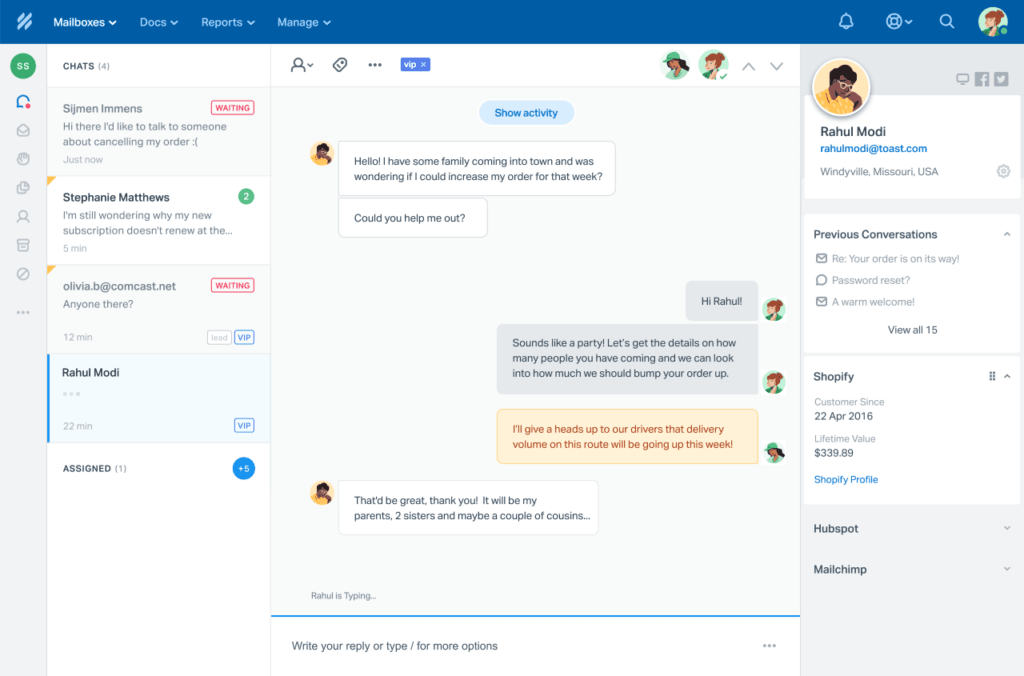
One of the things I really appreciate about Help Scout is how it helps you build personal connections with your customers. It has features like saved replies and collision detection to help you provide fast, efficient, and personalized support. This can really make a difference in building customer loyalty and satisfaction.
Help Scout also offers some great collaboration features, making it easy for teams to work together on customer inquiries. You can share notes, assign conversations, and track progress all within the platform. If you’re looking for a customer-centric and user-friendly email management tool, Help Scout is definitely worth checking out.
Pros:
- Collision detection feature to avoid duplicate replies and confusion
- Sleek and functional interface
- Saved replies to save time and ensure consistency in your customer communication
- Docs feature for creating FAQ pages and a Chat feature that enables real-time support
Cons:
- The search function is not very smart and sometimes fails to find what you need
- It lacks the functionality to merge multiple tickets at once
Pricing:
Starts at $20/user/month.
How Did I Evaluate the Best Customer Service Email Software?
To evaluate the email ticketing systems featured in this article, I followed a systematic and unbiased approach that ensures a fair, well-rounded review. My assessment is built on six key factors:
- User Reviews / Ratings: I analyzed real user feedback and ratings from reputable platforms like G2 and Capterra to understand how these tools perform in day-to-day use. This helped me gauge overall satisfaction and flag recurring pain points that teams commonly experience.
- Essential Features & Functionality: I closely examined the core capabilities of each system, including ticket creation from emails, automated routing, thread management, collision detection, and reporting. This allowed me to assess how well each tool handles the actual demands of managing email-based support.
- Ease of Use: I evaluated how intuitive each platform is to navigate, from setting up email inboxes to managing tickets and resolving queries. I paid special attention to whether support agents, regardless of technical skill, could hit the ground running without a steep learning curve.
- Customer Support: I looked at the quality of support each vendor offers its own users, including response times, available channels (live chat, email, documentation), and how effectively they help teams during onboarding and when issues arise.
- Value for Money: I compared each tool’s pricing against the features it offers, factoring in plan tiers, user limits, and any hidden costs. The goal was to help you determine whether the investment is justified for your team’s size and needs.
- Personal Experience / Experts’ Opinions: My evaluations are further informed by hands-on testing and insights from customer support professionals. These perspectives helped me go beyond feature lists to assess real-world performance and reliability.
My Top 3 Picks for Customer Service Email Management Tool
Still couldn’t finalize one option? Don’t worry! Here are my top 3 recommendations that will ensure your team never misses a customer email again:
1. ProProfs Help Desk
ProProfs Help Desk shines with its intuitive interface that requires little training, making it easy for teams to adapt quickly. The tool’s robust AI-powered automation, especially with features like intent analysis and response suggestions, boosts efficiency and helps deliver top-notch customer support.
2. Hiver
Hiver offers a user-friendly platform for managing emails, live chat, voice, and WhatsApp support from a single interface. With features like notes, approvals, and automation, it streamlines workflows, while built-in analytics enable performance tracking and help improve response times.
3. HelpSpot
HelpSpot offers a unified inbox, customizable workflows, and skill-based ticket routing to enhance transparency and accountability. Its knowledge base and collaboration features streamline ticket resolution, helping teams reduce response times and lower customer inquiries.
FREE. All Features. FOREVER!
Try our Forever FREE account with all premium features!
What Are Some Customer Email Management Best Practices?
Here’s a truth bomb: Even the best email management software can’t deliver results without the right processes in place.
By following a few proven email management best practices, you can reduce response times, improve agent productivity, and ensure every customer email receives the attention it deserves.
| Best Practice | Why It Matters | How to Do It |
| Use AI for Email Summaries & Response Suggestions | Reduces agent effort, speeds up response times, and helps maintain consistency. | Choose email management software with AI capabilities that can summarize long email threads and suggest context-aware replies. |
| Set Response Time Goals | Ensures customers receive timely support and prevents emails from piling up. | Define SLAs for different ticket priorities and monitor compliance through reports and dashboards. |
| Automate Routine Tasks | Minimizes manual work and helps agents focus on complex customer issues. | Create workflows to automatically assign, tag, prioritize, or escalate incoming emails. |
| Create Canned Responses | Improves efficiency and ensures consistent communication across the team. | Build a library of pre-approved templates for common questions, requests, and complaints. |
| Prioritize Urgent Emails | Helps resolve critical issues faster and improves customer satisfaction. | Use tags, priority levels, or AI-based intent detection to identify urgent emails automatically. |
| Organize Emails With Labels & Folders | Makes conversations easier to track and retrieve. | Create categories based on issue type, department, product, or customer segment. |
| Monitor Email Performance Metrics | Reveals bottlenecks and opportunities for process improvement. | Track KPIs such as first response time, resolution time, backlog volume, and CSAT scores. |
| Integrate With Your CRM | Gives agents complete customer context for personalized support. | Connect your email software with your CRM to access customer history, purchases, and previous interactions. |
| Regularly Clean Up Your Inbox | Keeps workflows organized and prevents important emails from being overlooked. | Archive resolved conversations and establish retention policies for old emails. |
| Train Teams on Email Etiquette | Creates a professional and consistent customer experience. | Develop guidelines for tone, formatting, personalization, and response quality. |
Fix Your Inbox Today & Deliver Faster Email Support
Managing customer emails doesn’t have to be an overwhelming challenge. With the right customer service email support software, you can transform your inbox from chaos to clarity, ensuring that no message slips through the cracks.
Incorporating the right tool can optimize your team’s workflow, enhance response rates, and lead to greater customer satisfaction.
If you’re looking for a reliable customer support tool, I suggest considering ProProfs Help Desk. It allows you to manage customer inquiries efficiently without breaking the bank while still benefiting from features like AI-powered summaries, canned responses, and automated ticket assignments.
Frequently Asked Questions
What is customer service email management software, and how is it different from a regular inbox?
It converts incoming customer emails into trackable tickets, so nothing slips through the cracks. Unlike a shared Gmail or Outlook inbox, it adds assignment, collision detection, SLA tracking, and reporting built for teams.
How many agents do I need before switching from a shared Gmail inbox to dedicated software?
Most teams feel the pain at three or more agents; duplicate replies, missed threads, and zero visibility become real problems fast. That's the point where a shared inbox or help desk tool pays for itself immediately.
What must-have features should I look for in customer service email software?
Prioritize shared inbox with collision detection, automated ticket routing, canned responses, SLA alerts, and reporting on response and resolution times. Everything else is a bonus until those five are covered.
Is there a good email management tool for small support teams on a tight budget?
ProProfs Help Desk is a strong option here; it offers a forever-free plan, which covers shared inbox, ticket prioritization, internal notes, and canned responses without the complexity or cost of enterprise tools.
Can this software handle emails from multiple support addresses like billing@, support@, and returns@?
Yes, most platforms let you connect multiple email aliases and funnel them all into one centralized dashboard, so agents aren't logging in and out of different accounts to stay on top of conversations.
Does AI actually help with email management or is it just marketing?
AI in mature tools does three concrete things: it auto-tags and routes incoming emails, suggests replies using past ticket data, and flags high-priority messages based on sentiment. The hype is real in those three areas; everything beyond that is still hit or miss.
What's the difference between a shared inbox tool and a help desk platform?
A shared inbox (like Front or Missive) is built for collaborative email management with a conversational feel. A help desk (like ProProfs Help Desk or Freshdesk) adds ticket tracking, SLA enforcement, and reporting, which is better suited for teams handling structured support at scale.
Will switching to email management software disrupt our current support workflow?
Most modern tools connect directly to your existing support email address, so customers notice nothing. Your team gets a new interface, but emails still arrive and are sent from the same address as before.
FREE. All Features. FOREVER!
Try our Forever FREE account with all premium features!

 We'd love your feedback!
What did you like & how can we make it even better?
 Thanks for your feedback!
 Ask Your Question
Have a question? Get expert help to make your decision easier.